Friday, February 1, 2008

Anticipation

By the time the middle of winter rolls around most gardeners are chomping at the bit for the arrival of spring color. Although, the appreciation for winter interest gardens has helped satisfy my yearnings for unique texture and bold colors. The Acer griseum (Paperbark Maple) that stands boldly in our garden showcasing its flaky, torn mahogany colored bark is gratifying. The Cornus alba ‘Bailhalo’ (Ivory Halo Red Twig Dogwood) grove, which encase the Picea orientalis ‘Skylands’ (Yellow oriental Spruce) are electrifying this time of year and the wheat-colored Calamagrostis ‘Karl Foerster’s, are tantalizing as they dance in the winter winds. However, even with all this going on in our garden I can’t help but dream about the explosion of color that’s ahead in just a few short weeks. Buds that seem over ripe and plump are ready to erupt and the unfolding of spring is just around the corner. Two plants that I have learned about in recent years are some of the most exciting for spring color and texture.

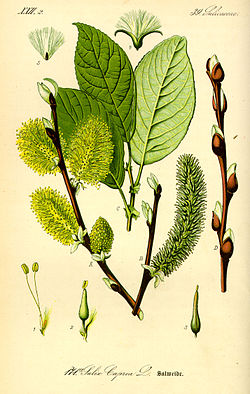
Salix yezo-alpina or Salix nakumurana (dwarf alpine willow) is a dwarf pussy willow that grows entirely prostrate. Native to the mountain slopes of Hokkaido Japan, this little wonder is as tough as nails. Able to survive harsh mountain terrain, yezo-alpina can take zone 3 temperatures (-40 to -30fahrenheit) without any problems. Growing only twelve inches tall and spreading six to eight feet, this handsome, garden groundcover plant can be a great alternative to the more pedestrian solutions of Pachysandra, Vinca minor (Periwinkle/Myrtle) and English Ivy. The most interesting attribute of this tiny plant has to be the large upright, two inch, catkins (pussy willow fuzzies) that we all just have to touch. This multi-seasonal plant offers something at every time of year. Along with the anticipated catkins, which incidentally are white and yellow, are the ovate, glossy green leaves, complete with white fur. Yes, fur! Google an image and you’ll see what I mean. As the seasons progress so does the foliage. What starts out in the spring as deep green finishes in the fall with outstanding yellow color complete with bronze and red highlights. Finally, the winter showcases thick purplish-mahogany bark hugging against the ground in a spidery format. Yezo-alpina does not crave excessive amounts of water as do other willow types. As for lighting conditions, they handle just about everything from sun to shade. However, the catkins seem to develop better in more sun. Suitable as a bonsai candidate, it develops a thick, tiny trunk with outreaching limbs. Other considerations for this dwarf willow include climbing down a rock wall or perhaps mass plant it, as we did, around a Salix caprea ‘Pendula’ (Kilmarnock Willow) and have silvery catkins everywhere.

Another favorite to look forward to is Forsythia viridissima var. koreana ‘Kumson’. This forsythia still has great golden blooms heralding the arrival of spring; however, it’s the foliage that will truly blow you away. Dark green leaves with silver venation remind one of an almost lizard-like skin appearance. More shade tolerant than other forsythia this one also has purple stems behind the yellow flowers. A moderate grower to six feet by six feet, Kumson offers interesting foliage that lasts through the fall. Tolerant to a wide range of soil types, as our most forsythia, this will benefit from heavy pruning. Prune Kumson right after its done flowering taking out the older, heavier canes. If you’re not so interested in the flowers and become enamored with the foliage, as I am, then prune again in mid-summer to appreciate more new growth with outstanding variegated foliage. Forsythia ‘Kumson’ has come to us by way of Korea through the efforts of Tim Wood of Spring Meadow Nurseries in Grand Haven, MN. What started out as a search for different types of hibiscus in 1999, at the Botanical Garden of Sungkyunkwan University, ended with the sleeper find of Kumson. The possibilities for this plant are endless. Force the stems in the winter for early indoor color. Use the plant as a quick screen in the sun or shade and appreciate eight months of beautiful foliage with a bonus month of golden flowers or simply plant one as a specimen in your garden.

There are so many plants to look forward to as the warmer seasons approach. However, there are plenty to appreciate this time of year as well. Today alone I came across an impressive witchhazel (Hamamelis x intermedia ‘Jelena’) with orange-copper tones. There are just so many plants and so little time.

Tuesday, January 1, 2008

Witch’s Broom

Tom Castronovo and the Gardener News will be hosting a symposium this April introducing their garden writers to the public. This event will cover a wide range of gardening topics, helping to educate those interested in the green industry. My topic of discussion will focus on “Smaller Plants for Smaller Spaces.” With residential property sizes shrinking in New Jersey, an emphasis on choosing smaller plants for smaller landscapes will be discussed. And while the topic implies small, there is in fact much to talk about. So much in fact that the topic of where some new plants come from will only briefly be discussed. This article however, affords me the opportunity to go in depth about one way plants are found and produced. So what is a Witch’s Broom anyway?

A witch’s broom is a mutation form occurring on an existing plant. Plant Geeks of the world, me included, hope to find these adaptations of plant life and develop new plants or cultivars from their find. This abnormality is a disease or deformity on a woody plant where the natural occurrences of the plant change. The result is a dense mass of shoots growing out from a single point resembling a broom or a bird’s nest. These congested growths are popularly found on spruce and pine, but are not limited to, as they can also be found on deciduous trees such as hackberry and maple. There are a number of “stresses” which can cause a witch’s broom. Both biological and environmental factors can contribute to the congested masses. Organisms such as fungi, phytoplasmas (bacterial-like organisms), mites, aphids, mistletoe and viruses are to blame biologically. Factors such as poor pruning practices or other physical damage to a tree may contribute to such an abnormality. Environmental stresses injure the growing points of branches, thus contributing to the formation of a broom. The cause of a broom can be difficult to determine, especially if the cause was an environmental factor. There may be only one broom on a tree or several. The abnormal growths create great opportunities for diversifying the plant world. Often diminutive forms of spruce and pine have been created that fit well into smaller landscapes. However, far too often are similar cultivars being raised, contributing to the confusion of similar, if not exact, plants.

There are innumerable witch’s brooms and the vocabulary of naming them is just as exciting. In 1904 a witch’s broom on a Norway spruce (Picea abies) was found and named ‘Nidiformis’. This well known dwarf Birds Nest Spruce type has a flat top and is wider than it is tall. Horizontal layers of branches with short green needles afford this candidate many landscape possibilities. In 1958 a witch’s broom was found on a witch’s broom in Holland. Picea abies ‘Nidiformis’ provided the world with Picea abies ‘Little Gem’. Little Gem has the tiniest of green needles and has been described as a “living rock”. Suitable in almost any garden, this dwarf conifer could be your next container garden candidate. Another mentionable favorite is Picea abies ‘Lanham’s Beehive’. Founded by Gary Lanham on a mature Norway Spruce, this one has a beehive form. The needles are longer and thicker than most other nest types. They (the needles) also have a slight glaucous tint (a waxy bloom or whitish material that rubs off) and the stems and buds are cinnamon colored. We’re really going deep now! ‘Picea glauca ‘Humpty Dumpty’ is a dwarf White Spruce whose origin is from the popular dwarf Alberta Spruce. This squatty form is as wide at the base as it is tall. The list goes on and on and the vocabulary just gets more interesting. “Thumbelina’ and ‘Witches’ Brood’ are two forms of dwarf Norway Spruce. “Tom Thumb’ is a bright gold, oriental spruce miniature with short, layered branches. This yellow form, and most others, likes a harmonious balance between sun and shade. While most green forms are happiest in sun.

The term witch’s broom comes from the German word Hexenbesen, meaning to bewitch (hex) a bundle of twigs (besom). The next time you go hiking, look around your surroundings up in the trees. You may be able to name your own plant and become immortalized in the plant world. Gardeners interested can obtain more information about witch’s brooms by visiting wbgardens.com. The website features Jan Salma who is a dwarf conifer collector from the Czech Republic. While the site is not the easiest to navigate, it does provide great photographs. Enjoy and happy hunting.

Saturday, December 1, 2007

Sugi: A Revered Conifer in Japan

With the holidays quickly approaching, there is a sense of urgency to decorate and adorn our homes. While Christmas trees are a small part of the holiday season, the selection of tree types is enormous. The popular candidates are Douglas Fir (Pseudotsuga menziesii), Fraser Fir (Abies fraseri), Balsam Fir (Abies balsamea), Grand Fir (Abies grandis), Noble Fir (Abies procera), White Fir (Abies concolor), Nordmann Fir (Abies nordmanniana), Colorado Spruce (Picea pungens) and Norway spruce (Picea abies). While these are all attractive Christmas trees most are also used for privacy screens and shade trees in our landscapes. Another Mega Conifer to consider for our landscapes is the very versatile Cryptomeria japonica (Japanese Cedar).

Today’s academics still list Cryptomeria as part of the Taxodiaceae family. Grouped with the likes of Metasequoia (Dawn Redwood), Sequoia and Sequoiadendron (Coast Redwoods and Giant Redwoods) as well as Sciadopitys (Umbrella Pine) to name a few. However, just as Sciadopitys is listed a few ways, also in the Pinaceae family, so to is Cryptomeria being pushed towards the Cupressaceae family (Cypress family). A discussion for the academics, there is no denying the vast potential of this conifer. Those who are introduced to Cryptomeria for the first time are usually enamored with its rope-like foliage, which is blue-green and rubbery to the touch. A broad pyramidal tree as an older specimen, Cryptomeria japonica can reach heights of 50-70 feet high by 20-30 feet wide. However, “Jomon Sugi” one of the largest specimens of Cryptomeria or Sugi known, found on the island of Yakushima, Japan, stands a mere 26.1 meters tall and is said to date back almost 3000 years. Sugi incidentally is the vernacular name for Cryptomeria in Japan and is quickly becoming adapted elsewhere. Other distinguishing attributes of this majestic conifer include bark which is reddish-brown, peeling in long strips, cones which are terminal and somewhat round and an ability to grow in a range of soil types. Sugi prefers sun to part shade and appreciates shelter from high winds. This easy to grow superstar fills out quickly and can be useful as a hedge/screen or specimen. One of the few conifers that will coppice (sprout back from cut stumps) you can cut back aggressively and rejuvenate older, overlooked trees. Look for purple-bronze overtones in the winter as well.

Native to Japan and arguably southern China, Cryptomeria has a plethora of cultivars to choose from. Cryptomeria j. ‘Black Dragon’ has a vigorous growth spurt early on and then slowly fills out to an appreciable 10-15 feet in as many years. Light green new growth ages to one of the darkest greens for all Sugi’s and is maintained in the winter. ‘Mignone’ has caught the attention of many people including my dear friends Mitch Krause and Jessica Cordts who recently bought out a collection and mass planted them around a Trochodendron tree. Monochromatic gardening at its best! ‘Mignone’ sports rope-like branchlets and has an overall dense appearance. This suitable dwarf cultivar eventually matures to an upright broad conifer. ‘Sekkan’ is an upright conifer with sulfur yellow markings. A quick growing cultivar adds a punctuation of color to any garden. A personal favorite is ‘Rein’s Dense Jade’. Unusual texture and jade green markings, this cultivar in more fastigiate than it is pyramidal. The needles are held tightly to the stem and the winter helps offer purple-bronze markings. There are 54 planted at our house in a hedge form creating a skeletal backdrop for a large garden room. Unprotected from the winter, they stand on the north, south, east and west ends and are glorious. Finally, ‘Vilmoriniana’ can fit into anyone’s garden. Pointed short needles lead you from green to a purple-bronze in the winter. A dwarf form that is dense and globose at maturity.

Sugi (Cryptomeria) the national tree of Japan is so revered in its native land that not only does it have its own stamp but it is often planted around temples and is part of sacred grounds. One notable house of worship is the Shrine at Ise, Japan. A Shinto shrine to the goddess Amaterasu omikami it is set within ancient forests of giant Cryptomeria. A name derived from the Greek kryptos (hidden) and meros (part) certainly contradicts and reveals much of itself. A conifer with bright green new growth, purple-bronze markings in the winter and bark that is reddish-pink in color and slightly scented, truly is a conifer for all seasons. Now, if we could only get them as a cut Christmas tree…that would be something.

Thursday, November 1, 2007

Winter Protection for Our Green Friends

According to Consumer Reports, the average depreciation value for all models of automobiles is 45 percent over the first three years. Having said this, most go to great lengths to protect an investment that’s depreciating. Checking fluids; changing the oil every three thousand miles, being mindful of the engine coolant, watching the power steering levels, radiator and battery fluids are all basic maintenance we pay particular attention to as we approach winter. Furthermore, spark plugs, brakes and lights are all on schedule to be checked, repaired or simply maintained throughout the year. We put snow tires on cars, sometimes chains and add water to engine coolants so they do not freeze when the bitter cold hits zero degrees. Shouldn’t the same attentions and commitments be implemented to protect our landscapes? After all, landscapes that are well maintained appreciate adding to the resale of your home.

FIRST AND FOREMOST, FALL IS AN EXCELLENT TIME TO PLANT TREES AND SHRUBS!! Plant material is going dormant and thus there is virtually no transplant shock. So feel free to move plants about your property, assiduously checking for the occasional fall dig hazard plants. Conversely, planting trees and shrubs simply means slipping the plant material into the ground which you have just purchased. Water requirements are far less as temperatures are plunging and you may even come across an occasional deal as plant purveyors are committed to depleting inventory this time of year.

Hopefully by now you have been diligently watering and fertilizing your plant material through summer and early fall. Watering can be decreased in early fall and should be increased towards the end of late fall to help protect trees and shrubs. Just before you turn your outdoor water off for the winter, give your trees and shrubs one last long, slow drink as this will help protect them from the drying winds of winter. Allow plants to go dormant. Don’t encourage growth by adding nitrogen fertilizers in the fall. This will stimulate top growth and force plants to reach and stretch at a time when they should be relaxing and ready to sleep. Phosphorous and potassium fertilizers will be better suited to help with winter acclimation. Consider wrapping younger trees with a commercial tree wrap, vinyl or paper, as you will protect them from desiccating winds as well as from “buck rub” (deer damage). Protecting evergreens from drying winds has always been a topic of debate. Antidesiccants (Anti-Transpirants) help protect broadleaf evergreens like hollies, rhododendron, azaleas and laurels, but should not be used to protect our needled friends. Spruce, hemlock, arborvitae, pines etc. should not be sprayed but rather have a burlap wall around them. Winter browning of evergreens is caused by a combined effect of wind and sun. Thus, these coniferous evergreens will benefit immensely by simply providing them with a line of defense. In this case a burlap wall. Thoughtfully select species and cultivars that will tolerate the given surroundings. Plant species that are susceptible to winter injury should be thoughtfully placed in areas of minimal exposure to winter wind and sun. In other words, don’t plant Prunus laurocerasus ‘Schipkaensis’ (Shipka or Skip Laurel) on the west side of your property, without protection, and expect great results. While one of the hardiest of the cherry laurels, this broadleaf evergreen found near the Shipka Pass in Bulgaria, is often placed in wind tunnels only to succumb a most certain death.

Mulching your trees, shrubs and perennials for the winter is very important. However, doing it properly is even more important. Two to four inches of mulch around your plants is plenty. Too much mulch is just as bad as too little mulch. Aside from aesthetics, the purpose of mulch is to regulate and control temperature and hold moisture. Too little and plants can dry out. Too much and plants can rot. Always be mindful to keep the mulch material away from direct contact with the bark of trees.

Finally, there is still enough time to plant bulbs for next year. The ground should still be “workable” and thus you can add tremendous excitement to your garden by having bulbs peek out early next spring. The pedestrian types such as Tulips, Hyacinths and Crocus are always welcome; however consider Scilla, Chionodoxa, Allium and Fritillaria to spice things up a bit. Remember, Narcissus (Daffodil) is always a good staple bulb that not only naturalizes but is “Deer Proof”. All will look great emerging somewhere between the flowering of Hamamelis (Witchhazel) and the Mahonia (Oregon Grapeholly).

Monday, October 1, 2007

Cathaya argyrophylla: An Endangered, Uncommon Conifer

John Stella (John Stella Horticultural Sales) is a friend, colleague and plant enthusiast whose vast botanical knowledge is not only encyclopedic, but seldom rivaled. John often refers to certain plants as “BIO Plants”, an acronym for Botanical Interest Only. His usage as an adjective is often out of fascination, admiration or trivial interest for plants. Hidden from the world until 1955, the genus Cathaya was virtually unknown and today still stumps the most inquisitive horticultural minds.

Imagine a trek, totaling several days, climbing mountainous terrain, in search of a rare conifer only to be met by bureaucratic resistance. Resistance layered with local police, the local tourist bureau, the forestry department, the public secretary bureau, the Mayor’s office, and the Chinese army. Known only as a fossil record from tertiary sediments in Eurasia, Cathaya was rediscovered in 1955 by Chinese scientists in southeastern Szechwan and has been found growing in parts of Hunan, Guangxi, and Guizhou. Jinfu Shan, the destination for our early explorers, was home for this extraordinary conifer. A member of the pine family (Pinaceae) this monotypic conifer (a sole member of its group or single species) seems to favor limestone outcrops and areas of heavy summer rain. Extremely rare in cultivation, this curious conifer has similarities to the following genus groups: Abies (fir), Picea (spruce), Tsuga (hemlock), Pseudotsuga (Douglas fir), Larix (larch), Cedrus (cedar) and Pinus (pines). An evolutionary marvel, Cathaya has its embryo and pollen resembling that of true pines (Pinus), its wood similar to Douglas fir (Pseudotsuga), and its overall habit and seed producing cones reciprocal to spruce (Picea).

After an arduous journey to the United States from the People’s Republic of China, we have Dr. James Waddick of Kansas City, Missouri to credit Cathaya’s arrival. Dr Waddick has been “Championed” for distributing Cathaya argyrophylla to the Western World. Forwarded from the offices of the Conifer Conservation Programme at the Royal Botanic Garden, Edinburgh, the Arnold Arboretum of Harvard University and Iseli Nursery in Oregon were among the first to be bestowed with the treasures of Cathaya. Andre Iseli, former owner of Iseli Nursery, the conifer capital of the world, was determined to be the first person to acquire the seed of Cathaya. Since 1991, Iseli has received six different seed crops from various sources and in 1995 successfully germinated four seeds. From these four seeds, two remain at Iseli Nursery, one standing over six feet tall now. One continues to grow at Andre Iseli’s garden and the forth was auctioned at the Conifer Society in 2000 after being donated by Iseli Nursery.

The cold hardiness of the plant is still under review. Iseli Nursery, after successfully germinating several seeds from a 1998 crop, selflessly gifted twenty specimens to friends throughout the country. In an effort to determine the plants hardiness, Iseli only asked for feedback as to how the plant performs from region to region. Among the few to receive such a gift, I can say that the plant performs admirably in central New Jersey and has not been browsed by deer. Time will Tell! Aesthetic similarities include that of Sciadopitys (Umbrella Pine) and Cunninghamia (China fir) as its needles are long and wide.

The word argyrophylla literally means “silvery leaves”. The lush green leaves, in fact have a silver underbelly. Growing amongst such familiar plants as rhododendrons, cotoneaster and enkianthus the initial grove of Cathaya, standing some ten meters (thirty-three feet) must have had an indelible impression for the chosen few who first meet them. Despite the initial bureaucratic red tape those early plant hunters encountered, a call to the governor and some political pull not only allowed trespassing, but permitted the touch and photography of these historical creatures. “They have hid from the modern world until only recently. Pondering the pressure of more than six billion people and the pollution from our industrialized world, I wondered whether the trees would have been better off remaining hidden” (Pacific Horticulture 2001). Despite the efforts of footholds filled with concrete, rough areas that were smoothed over that would have served as grips and installing barriers of rock and concrete, the elevation of 5600 feet was reached. Through the mist and beyond the dense thicket of bamboo stood the grove of Yinshan (the Chinese name for Cathaya argyrophylla). Thankfully there are those among us who have the forward thinking to honor the past by protecting it and ensuring its survival by careful and thoughtful toils. Thank you to the People’s Republic for understanding that preservation can endure without simply hiding the truth and to Iseli Nursery for their cutting edge science and remarkable generosity to pay it forward.

Saturday, September 1, 2007

Funky Genus

Edson Arantes do Nascimento, Reginald Dwight, Gordon Sumner, Agnes Gonxha Bojaxhiu and Norma Jeane Mortenson (Baker) all have achieved worldwide recognition. However, these five people are all better known by such names as Pele, Sir Elton John, Sting, Mother Teresa and Marilyn Monroe. It seems that their born names were not as catchy, desirable or fitting. The same can be said for the genus Funkia. A genus pressing more than 70 species of lily-like plants and native to northeast Asia, Funkia seems to have been replaced by the more popular name Hosta. And while the rejected generic name is still found in some older literature and the occasional trade publication of perennials, Hosta has for the last quarter century been more popular.

Those of you who grew up in Union County in the early 1970’s, particularly those involved with the garden center industry, no doubt remember two sisters in Scotch Plains who supplied perennials to a large number of nurseries. The “Ditzel Sisters” are remembered today as two women who would greet you in the morning with pancake batter on their sleeves and sell “Jersey Grown” perennials later in the day. With a cleverly conceived, segmented, garden spade that was quartered, they could outwork nearly anyone as they would dig and market their plants. Ditzel Farm was across from today’s Union County Votech and is sited here because they marketed and sold hosta, only they called it Funkia.

The etymology of Funkia comes from the work of Heinrich Christian Funck, a German botanist and pharmacist (1771-1839). Displaced later by Austrian physician and botanist Nicolaus Host (1761-1834) the genus name, first and last, has honored the works of both men. The word “Funky” has had its share of negative connotations, thus its Hosta’s turn in the sunlight. Or is it?

While the name is basking in the limelight, Hosta much prefers the canopy cover of deciduous counterparts and coniferous friends. Protected from hot afternoon sun, Hosta is happiest in filtered light and survives admirably in shade. Herbaceous perennial plants, hosta grow from corms or rhizomes and have broad lanceolate or ovate leaves. Leaves that range in size from one inch to over a foot and equal in width. Though typically thought of as a green plant, hosta can surprise with some tantalizing variegated forms and glaucous waxy leaf textures. Generally an easy, long lived plant, relatively free of disease and requiring little maintenance, just water and the occasional plant food, hosta does have a few enemies. Deer, slugs and snails seem to enjoy these broad-leaved friends of ours almost as much as we do. However, as we are enticed visually by the kaleidoscope of colors they have to offer, these predators are bellying up for a culinary feast.

With some three thousand + named and registered varieties already and an almost equal number hoping to become registered, the possibilities are staggering for this herbaceous perennial group. ‘Guacamole’ is a newer, fragrant cultivar offering huge, shiny, chartreuse green leaves with a pronounced blue edge. ‘Blue Mouse Ears’ has small gray-green leaves and a texture so thick you have to touch it to believe it’s not artificial. ‘Patriot’, a sport of ‘Francee’ has a dark green center with pronounced white outer markings which are sizably wider (1997 American Hosta Growers Hosta of the Year). ‘Frances Williams’ needs no introduction as it seems to be the most popular of the lot. Heavily corrugated foliage with blue-green and yellow margins keeps this at the top of my list. Finally, rounding out my short list of favorites is ‘Tattoo’. Introduced at the 1994 Atlanta Hosta Convention, this beauty has bright gold leaves, each tattooed with a green outline of a maple leaf in the center, topped off literally with lavender flowers in early summer.

As a proud, upstanding member of the Conifer Society it almost seems sacrilege to talk so prominently of the perennial kingdom. However, realizing that conifers can only be enhanced by the bold textures of deciduous ornamentals, annuals and perennials, I digress in the enjoyment that this genus is there to be enjoyed and showcase the kings of the plant world…Conifers. And I suppose visa versa. Webster’s Dictionary defines “funky” as having an earthy style and feeling. Apropos for the once named Funkia. Finally, there are a number of web sites supporting the genus. Those in particular are www.hosta.org (The American Hosta Society), www.hostalibrary.org (for great Hosta pictures) and www.hostahem.org.uk/ (British Hosta and Hemerocallis Society). Whether you call it Funkia, Hosta, Corfu Lily, Day Lily, Plantain Lily or the Japanese name Giboshi this genus offers enough variety to enhance any garden.

Wednesday, August 1, 2007

Monkey Puzzle?


In 1947 director Joseph L. Mankiewicz coupled Rex Harrison and Gene Tierney in a romantic-comedy The Ghost and Mrs. Muir. Previously a novel written by Josephine Leslie penned under the pseudonym R. A. Dick and later a television series from 1968 to 1970, this romantic story has captivated audiences for nearly sixty years. Gardeners have referenced the movie to me on numerous occasions citing the rhetoric between Mrs. Muir (Gene Tierney) and Mr. Coombs (Robert Coote). “What a hideous tree. Quite! What kind of tree is it? I believe it’s called a Monkey Puzzle tree. Why? Because it defies the efforts of monkeys to climb it I presume. Ruins the view! I’ll have it chopped down.” Referenced by adults to me as unusual, spiny, odd, and exotic and by kids as simply “Cool”, this tree has sparked interest and attempts to plant it rival the efforts of those who go to great lengths to protect their precious fig trees in the winter.
Academically hardy to zone 7, there are specimens found in central and north Jersey where we are clearly a zone 6. Sited properly in alcoves or away from wind tunnels, I have seen this coniferous evergreen, related to the indoor houseplant Norfolk Island Pine; do well even without the help of a burlap wall for winter protection. Specifically, our garden center in Berkeley Heights, New Jersey had a single specimen for over 10 years. Situated within a northwest corner alcove of our building, it simply outgrew its surroundings and sadly was taken down. However, as a good friend and mentor of mine, Jock Demme of Iseli Nursery, often says, “Like it for as long as you can.” We did!!
My introduction to this tree was some 15 years ago on a buying trip in the Pacific Northwest. Bouncing from nursery to nursery, hand picking our nursery stock for the following year, I drove past an enormous specimen, some 70 feet tall, with rope-like arms covered with spiny, leathery, razor sharp, triangular, green leaves. The leaves are affixed for some 10-15 years before being replaced. These horizontal, spreading branches grow in whorls and are evenly spaced in tiers. Branching some 30 feet across, this imposing tree was a handsome lawn specimen with a trunk that looked like the foot of an elephant, complete with dark gray-brown, wrinkled bark. Majestic in its stature this Monkey Puzzle tree is visited every year I return.
Araucaria araucana (Monkey Puzzle) was introduced during the late 1700’s. Native to the volcanic slopes in the Andes Mountains of Chile and Argentina, it is often referred to as a Chilean Pine. Broadly pyramidal and sometimes oval are mature outlines to look forward to. The most cold hardy of some 18 species, Monkey Puzzle enjoys full sun to part shade and well drained soil. Tolerant of winds and salt spray I have seen a hedge of these towards the Oregon coast. Monkey puzzle is dioecious (has separate male and female trees). Female trees produce a 6” egg-shaped cone that takes 2-3 years to mature. Notable to mention, female trees have been measured consistently larger than their male counterparts. The cones can contain 80-200 large, edible seeds and are used for medicinal purposes a well as a food source for people. Likened to the taste of pine nuts, these edible seeds can be eaten raw or cooked and are high in starch. The resin, incidentally, has been used in the treatment for ulcers and open wounds. Finally, the genus is said to be named after the Arauco Indians whose territory was amongst the natural stands of the species.